

With your child now in the Upper Primary years, the focus shifts towards building the skills and knowledge needed for PSLE. We’ve been conducting subject-specific parent briefings throughout January to help you understand what it takes to excel at this level.
Here’s a summary of key pointers from our Primary 5 & 6 briefings:
English: Using ALP, REAP & PEERS frameworks to tackle comprehension and oral
Maths: How Power Codes help students tackle problem sums systematically
Science: Using CCC and AIR frameworks to answer open-ended questions
Chinese: Systematic techniques for comprehension, composition, and oral
Our bundle discount (up to 20% off) ends on 31 January — register now to secure the best savings, or chat with us on WhatsApp if you have questions.
PSLE English: What It Takes to Score
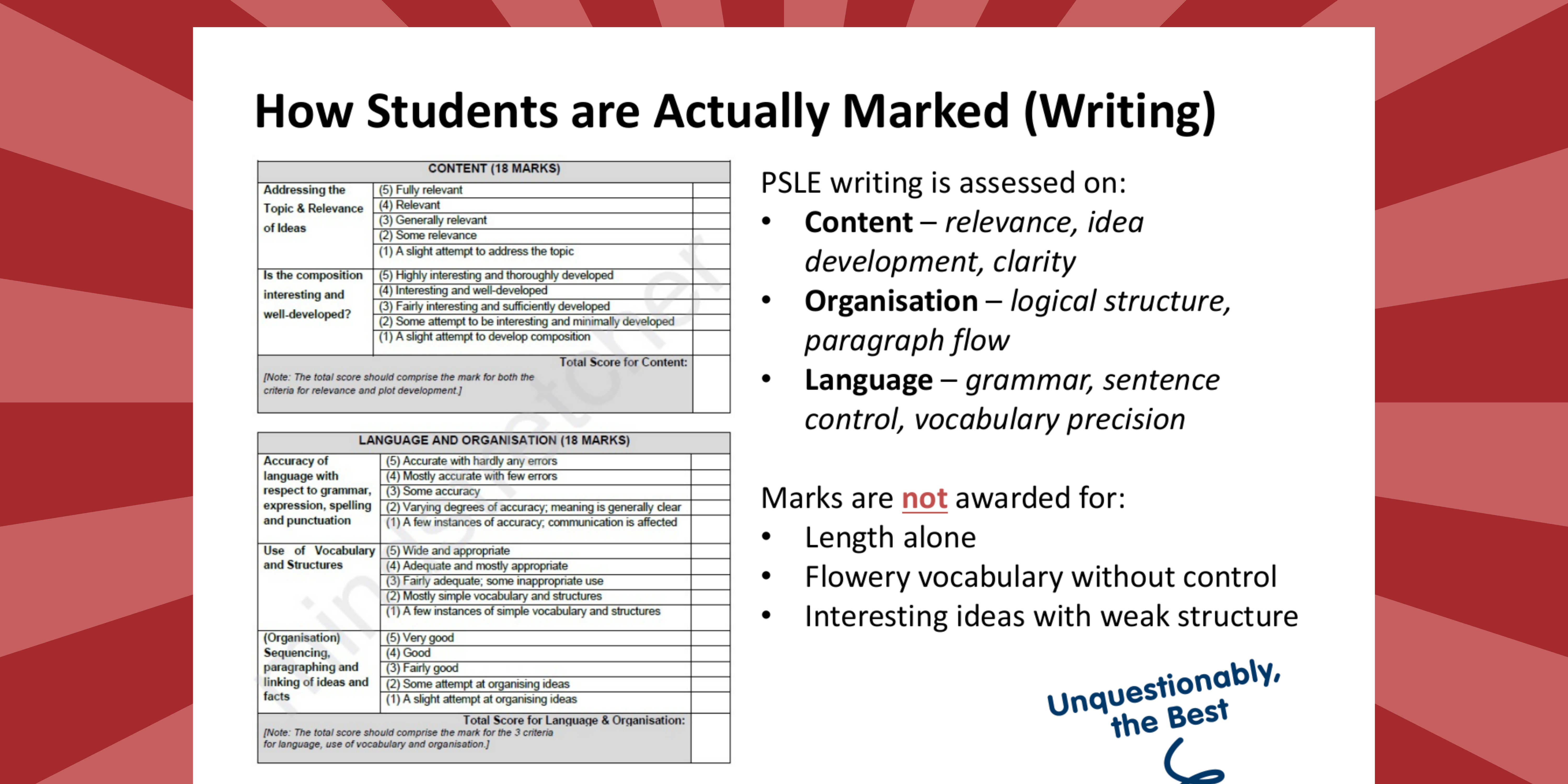
Many students write lengthy compositions but don’t score well — because idea development and structure matter more than word count.
Writing: The rubric rewards relevance, clear idea development, and controlled grammar — not length alone or flowery vocabulary without control. Students who plan before writing tend to score higher than those who simply write more.
Comprehension: Students often lose marks by giving vague or overly long answers. The key is precision — using the A.L.P. method helps: Analyse keywords in the question, Look for evidence in the text, then Phrase answers that directly address what’s being asked.
Oral: Many students have ideas but struggle to express them clearly under pressure.
For Reading Aloud, the R.E.A.P. framework covers what matters: Rhythm, Expression, Articulation, Pace.
For Stimulus-Based Conversation, P.E.E.R.S. guides well-structured responses: state your Point, Explain through examples, share your Experience, Recommend a solution, and Summarise.
Watch the full P5 & 6 English Briefing →
PSLE Maths: Tackling Problem Sums with Power Codes

PSLE Maths increasingly tests reasoning and application — students need to show their method of solution, not just the answer.
Use structured problem-solving strategies. We teach Power Codes — step-by-step frameworks that help students identify question types and apply the right method. Instead of trial and error, students learn to recognise patterns and solve systematically. This builds confidence especially for multi-concept and non-routine questions.
Show clear working for Paper 2. Even a correct answer with no working may not get full marks. Practise writing solutions in a structured, step-by-step format.
Don’t underestimate P4-P6 topic revision. PSLE questions often combine multiple concepts and skills — a single problem sum may require students to apply knowledge from different topics learned across P4 to P6.
Build number sense and checking habits. Top scorers verify their answers by working backwards and estimating whether their answer is reasonable.
Watch the full P5 & 6 Maths Briefing →
PSLE Science: Scoring on MCQ & Open-Ended Questions
At this level, Science questions require students to apply concepts — not just recall facts.
For MCQs: Eliminate systematically. Don’t just pick the first option that looks right – go through all options, eliminate the clearly wrong ones, and verify the remaining answer against the question.
For open-ended questions: Analyse the question, then structure your answer. Many students lose marks because their answers are vague or missing key terms.
C.C.C. (Question Analysis): Before answering, identify the Command word (State, Describe, Explain, Suggest), the Concept being tested, and the Context of the question. This ensures students understand what depth of answer is required.
A.I.R. (Answering): Structure responses with a clear Answer, support it with Information from the question or prior knowledge, then explain the Reasoning that connects them.
Use correct scientific terminology (e.g., “photosynthesis”, “evaporation”, not “the plant makes food” or “water disappears”) and match answer depth to marks allocated.
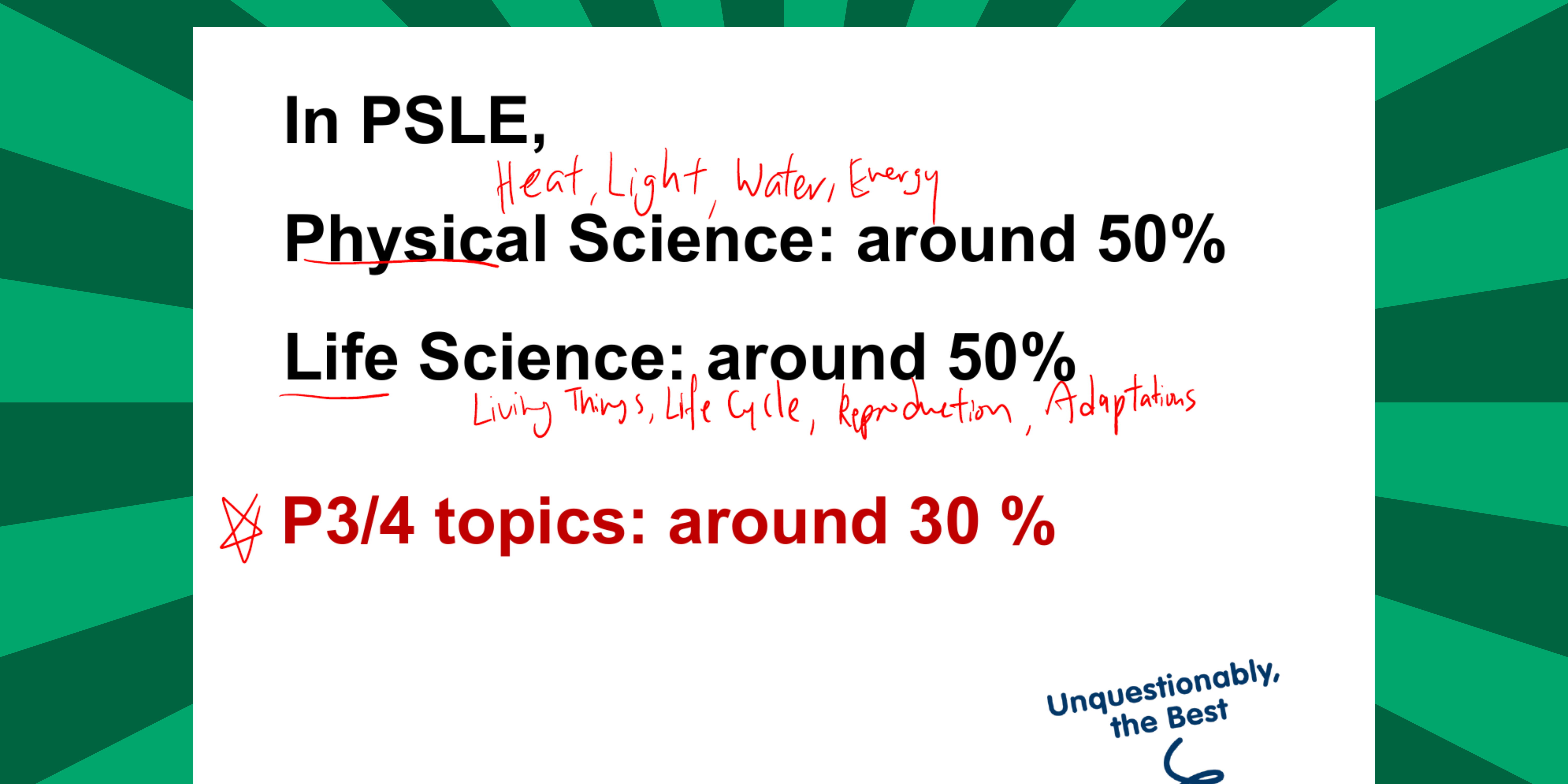
Don’t neglect P3/P4 foundations. About 30% of PSLE Science draws from earlier topics.
Manage time carefully. With 1 hour 45 minutes for the whole paper, aim for ~45 minutes on MCQs (including checking and shading) and ~1 hour on structured questions.
Watch the full P5 & P6 Science Briefing →
PSLE Chinese: Systematic Techniques for Every Component

Chinese has four major components — Vocabulary (20%), Comprehension (21%), Composition (20%), and Oral (25%).
Comprehension: Use the three-step method (三步答题法) — Find keywords from the question in the passage, Underline relevant sentences, Modify text into your answer. Many students copy directly without modification and lose marks.
Composition: Students who use STAR method (Speak, Think, Action, Reaction) write more engaging compositions with richer character development — exactly what the marking rubric rewards.
Oral: Structure video descriptions with 4W — When, Where, Who, What. For follow-up questions, prepare responses on common topics (reading habits, healthy eating, internet use) and practise giving school-related suggestions.
Upcoming briefing: P5 & P6 Chinese & Higher Chinese Parent Briefing — Sat, 17 Jan, 2:00 PM
2026 Registration: Bundle Promotion Ends 31 January
Our bundle discount (up to 20% off) runs till 31 January. Register for multiple subjects now to enjoy the best savings for AY 2026.
Register for AY 2026 → | Chat with Us →
If you’d like to experience classes first, make use of our 1-week unlimited trial classes to try all subjects across all centres before committing.
Upcoming: PSLE Excellence Series & Super Sessions
Dive deeper into PSLE preparation with our complimentary online workshops:
PSLE 2026 Excellence Series
English — Fri, 30 Jan, 7:30 PM
Science — Sun, 1 Feb, 2:00 PM
Maths — Fri, 6 Feb, 7:30 PM
Chinese & HCL — Sat, 7 Feb, 2:00 PM
PSLE Chinese Super Sessions
3 Steps to Ace PSLE Chinese Comprehension — Sat, 24 Jan, 2:00 PM
Writing A* PSLE Chinese Picture Compositions — Mon, 26 Jan, 7:30 PM
Register for all free sessions →
January Briefings for Other Levels
Have children at other levels? View our subject briefing summaries: